
An SEO proposal is the document an agency or consultant sends a prospect to win the work: what you found, what you will do about it, what they will receive, how success will be measured and what it costs. The strongest proposals are built on the prospect's own data, not on generic promises.
This guide walks through each section, the deliverables to list, how to use the prospect's Search Console data for the audit (with their permission), how to set goals you can measure and report on, and ends with an outline template you can copy.
What a good SEO proposal does
A proposal has one job: to let the decision-maker say yes with confidence. That means answering four questions in plain language:
- What is happening on our site now? Evidence, not opinion.
- What will you do? Specific work, in order, with an owner.
- How will we know it is working? Metrics, a baseline and a reporting rhythm.
- What does it cost and what are the terms? Scope, price, duration, what's excluded.
Most weak proposals fail the first and third questions. They list services ("on-page optimization, technical SEO, link building") without tying them to anything the prospect can see on their own site, and they promise outcomes nobody can guarantee. Google's own guidance for site owners hiring an SEO warns that "no one can guarantee a #1 ranking on Google" and suggests asking an SEO how they measure success and in what timeframe they expect results (Google Search Central: Do you need an SEO?). A good proposal answers those questions before the prospect asks.
SEO proposal vs SEO RFP response
Sometimes the prospect comes to you; sometimes they send a request for proposal (RFP) with their own structure and questions. The content is the same, but the rules differ:
| Your own proposal | Responding to an SEO RFP | |
|---|---|---|
| Structure | Yours | Theirs: follow their section order and numbering |
| Questions | You decide what to answer | Answer every question, even with "not applicable" |
| Data access | Usually you can ask for Search Console access | Often you get none; ask in the clarification round |
| Pricing format | Your packages or a custom scope | Their pricing table, often per line item |
| Evaluation | One decision-maker, usually | A scoring panel comparing several responses |
With an RFP, compliance comes first. A response that ignores the requested format often gets scored down before anyone reads the strategy. Put your own structure inside their sections, not instead of them.
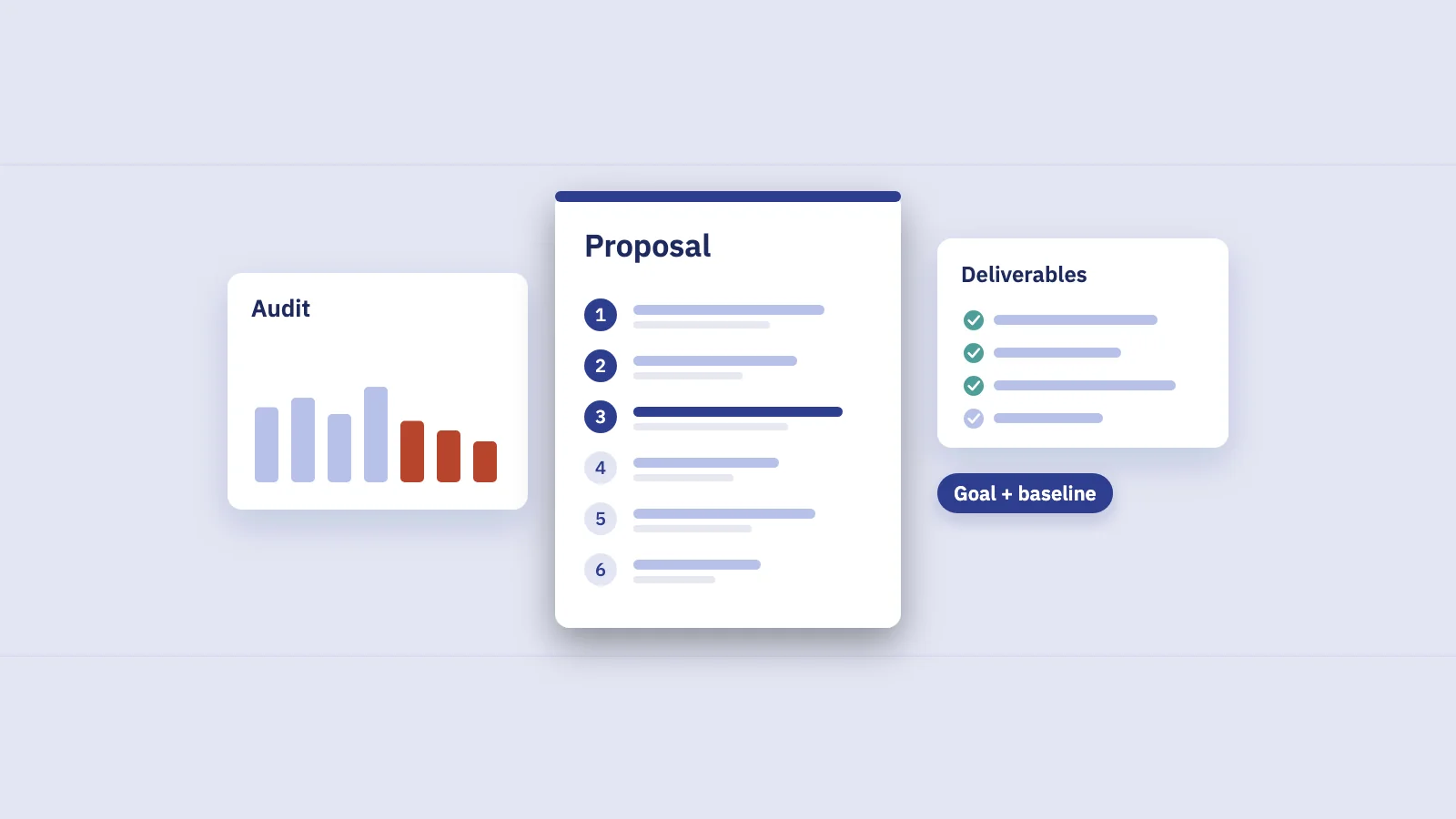
The sections of an SEO proposal
A proposal that covers the following, in this order, reads naturally from problem to plan to price.
1. Executive summary
Half a page. The prospect's goal in their words, the two or three biggest findings, what you recommend, the expected timeline and the investment. Many readers stop here, so it has to stand on its own.
2. Goals and context
What the business wants from search: more leads for a service line, sales in a category, visibility in a new market. Note constraints you learned in the discovery call (a migration planned, a small content team, a regulated industry). This section shows you listened.
3. Audit findings
The evidence. This is where the prospect's own data does the persuading, and where most of your effort should go. See the next section for how to build it from Search Console.
4. Strategy and scope of work
What you will do, grouped into workstreams (technical, content, on-page, internal linking, reporting), each tied to a finding from the audit. If a recommendation doesn't trace back to a finding or a goal, ask whether it belongs.
5. Deliverables
What the client actually receives, listed concretely. See "SEO deliverables to list" below.
6. Timeline
Phases with months, not just a list of tasks. Show what happens first and why (usually technical blockers and quick wins before larger content work), and when the first results read-out is.
7. Measurement and reporting
The metrics, the baseline, the targets and the reporting cadence. More on this below.
8. Team and process
Who works on the account, how you communicate, how changes to the site are approved, and how you'll document every change you make. Google's guidance specifically suggests asking whether an SEO will explain all changes made to the site.
9. Investment and terms
Price, billing, contract length, notice period, what's out of scope (paid ads, development hours, content production beyond an agreed volume). State it clearly; an unclear price section creates more questions than a high one.
10. Next steps
What the prospect does to start: sign, grant access, book a kickoff.
How to use the prospect's Search Console data for the audit
Generic audits based on crawlers and third-party estimates tell the prospect what any tool would. Their own Search Console data tells them what Google actually showed and what searchers actually clicked. It's also the data they can verify themselves.
Ask for access, and ask for the least you need. Search Console has owners, full users and restricted users (Google: Manage users and permissions). A restricted user can view most data and can't change settings or add users, which is enough for an audit. Google's own hiring advice is to grant only read access to Search Console at the audit stage. The prospect adds you under Settings > Users and permissions > Add user. Put the request in writing, say what you will look at and that you'll ask them to remove access if they don't go ahead.
Then build the audit section from the Performance report (Performance > Search results):
- Set the context. Show clicks and impressions over the last 16 months, the full range the report keeps (Performance report help). Mark obvious events: a redesign, a migration, a seasonal peak.
- Split brand from non-brand. Use a Query filter with Custom (regex) for the brand name and its misspellings, then the "doesn't match" version. Non-brand search is usually where an SEO engagement can make a difference, so size it separately. Our guide to branded vs non-branded traffic has the filter setup.
- Find the near-misses. In the Queries tab, sort by impressions and look for queries with an average position around 5 to 20. These are pages Google already considers relevant that sit just below where clicks happen.
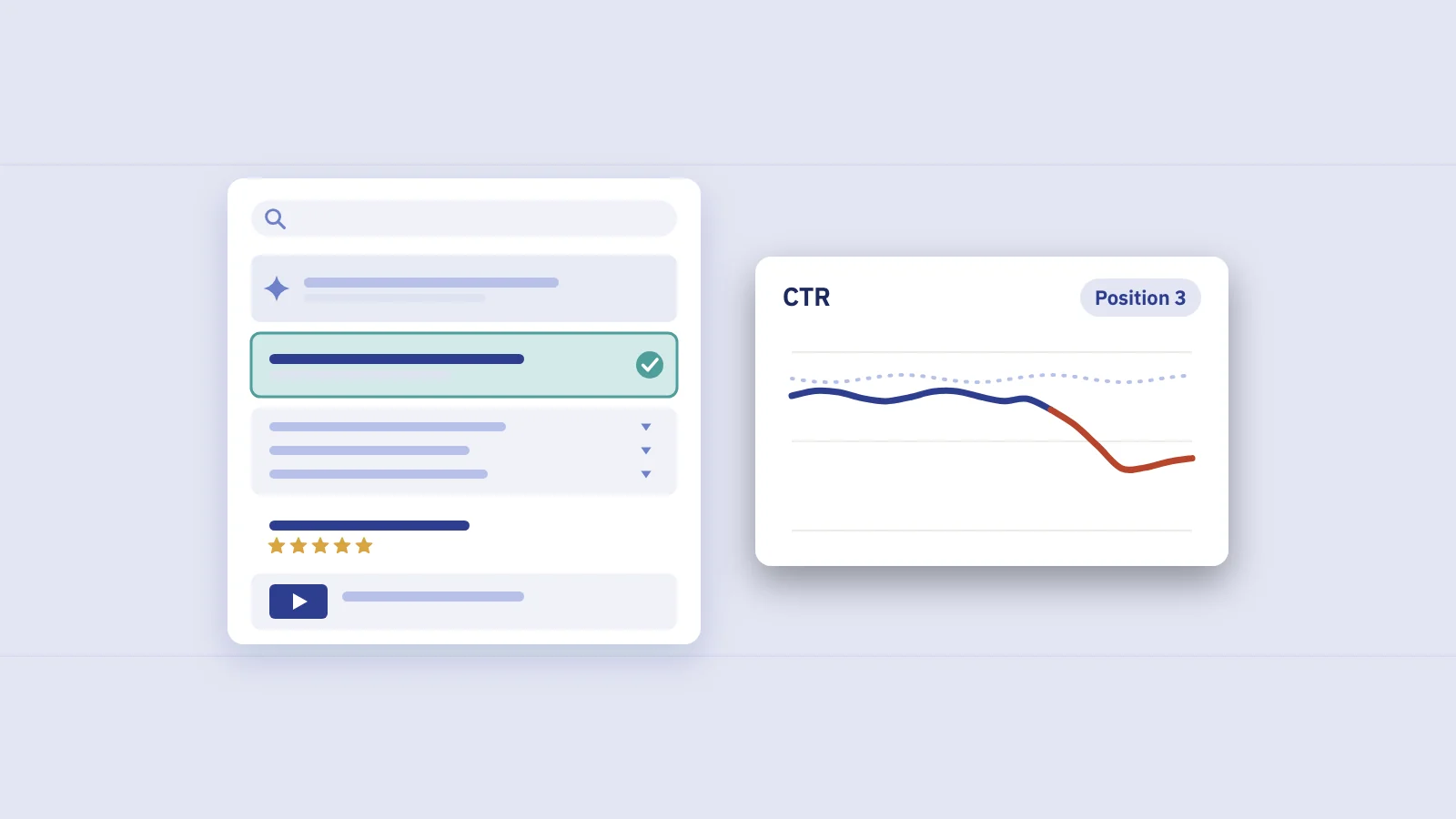
- Find CTR gaps. Queries where the site ranks well but earns fewer clicks than similar positions on the same site point to titles and descriptions worth rewriting.
- Find decline. Use Compare on the date filter for the last 3 months against the same months a year earlier and sort the Pages tab by the clicks difference. Pages losing clicks year over year are usually the fastest wins (see content decay).
- Check for split queries. Filter on an important query and open the Pages tab. Two of the prospect's URLs sharing its impressions is a cannibalization finding.
- Check indexing. The Pages report under Indexing shows why URLs aren't indexed. Look for important pages in the not-indexed reasons.
Present each finding the same way: what the data shows, why it matters, what you recommend. Use their numbers, but frame anything you project from them as an estimate, not a promise. If the prospect won't give access, say so in the proposal and keep the audit section to what you can see from outside, with a note that the first month includes a full data audit.
Treat the data you see as confidential. Don't put a prospect's figures into case studies or other proposals, and ask them to remove your access if the deal doesn't go ahead.
SEO deliverables to list
Deliverables are what the client can point to at the end of a month. Name them concretely, with quantities where it makes sense:
| Workstream | Example deliverables |
|---|---|
| Audit | Technical and content audit document; prioritized issue list |
| Keyword research | Keyword list grouped by topic and intent, mapped to pages |
| Technical | Fix specifications for the development team; check after each fix |
| Content | Content briefs; refreshed pages; new pages, with an agreed number per month |
| On-page | Title and description rewrites; internal linking changes |
| Reporting | Monthly report; quarterly review meeting; change log |
Avoid listing hours or activities as deliverables ("10 hours of link building"). Clients can't check activities; they can check documents, pages and reports.
Setting measurable goals
Every goal in the proposal should have a metric, a baseline, a target and a date. Search Console gives you the first two directly.
- Use metrics the client can verify: non-brand clicks, impressions, clicks to a group of pages, number of target keywords in the top 10. Our guide to SEO KPIs covers which to pick.
- Take the baseline from their data, over a fixed window, and write it into the proposal.
- Set targets as ranges and directions, not guarantees, and say what they depend on (content volume, development time for fixes).
- Compare like with like. For seasonal businesses, measure year over year, not month over month.
If you want to show what a target is based on, a forecast from the prospect's own impressions and click-through by position, given as a likely range, is more honest than a single number.
Reporting cadence
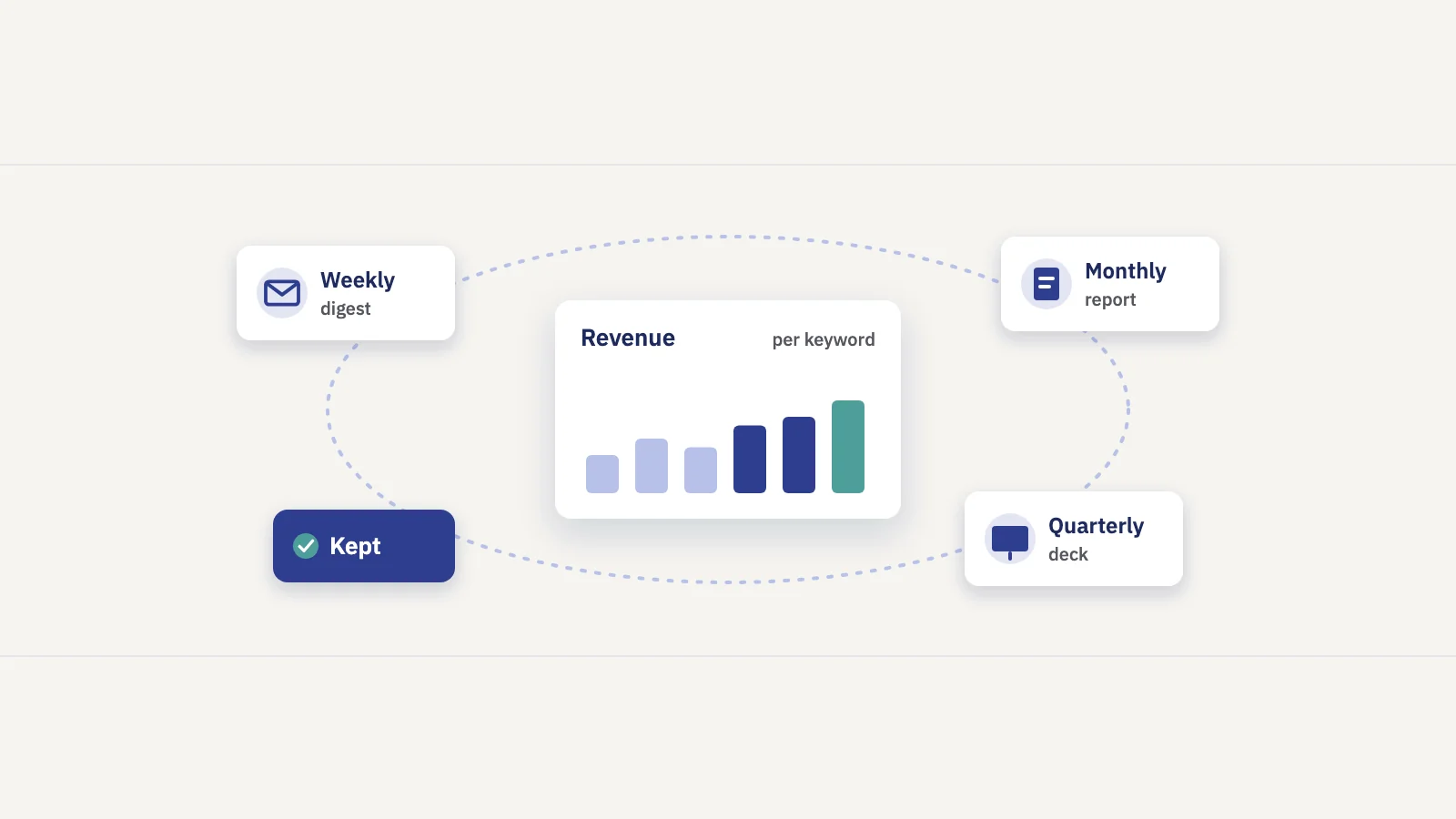
State how often the client will hear from you and what each touchpoint contains:
- Monthly report: results against the baseline for each goal, work completed, work planned, and anything that needs the client's input.
- Quarterly review: a meeting to look at the trend, re-check priorities and adjust the plan.
- Alerts between reports: for large drops or indexing problems, an email the same week instead of waiting for month-end.
- A change log: every change to the site with its date, so results can be read against what was done.
Agree on the format before you start. Our SEO report template covers what a monthly report should include. In Serplyze, scheduled reports go out by email on the cadence you set, as a read-only share link or a PDF, and can carry your agency's branding with the Agency add-on.
SEO proposal outline template
Copy this structure and fill each section from the discovery call and the prospect's data.
- Cover: client name, proposal title, date, your contact.
- Executive summary: goal, top findings, recommendation, timeline, investment (half a page).
- Goals and context: business goals for search, constraints, what success looks like for them.
- Audit findings: 4–8 findings, each with what the data shows, why it matters and the recommendation. Note the data source and date range.
- Strategy and scope: workstreams, each linked to findings and goals; what's in and out of scope.
- Deliverables: a table by workstream with quantities per month.
- Timeline: phases by month, first read-out date.
- Measurement: metrics, baselines, targets, how and where they're measured.
- Reporting: cadence, formats, who receives what.
- Team and process: people, communication, approval of changes, change log.
- Investment and terms: pricing, billing, duration, notice, exclusions.
- Next steps: signature, access requests, kickoff date.
Frequently asked questions
What should an SEO proposal include?
An executive summary, the prospect's goals, audit findings from their data, the strategy and scope of work, a list of deliverables, a timeline, how results will be measured and reported, the team and process, pricing and terms, and next steps.
How long should an SEO proposal be?
Long enough to show evidence and a clear plan, short enough to read in one sitting. The executive summary should work alone; detail can go in an appendix.
Should I ask a prospect for Search Console access before sending a proposal?
Yes, if they're willing. Ask for restricted (read-only) access, say what you'll look at, keep the data confidential and ask them to remove access if they don't proceed. Their own data makes the audit specific and verifiable.
What are typical SEO deliverables?
Audit documents, keyword research mapped to pages, technical fix specifications, content briefs, new and refreshed pages, title and description rewrites, internal linking changes, monthly reports and a change log.
Can an SEO proposal guarantee rankings?
No. Google states that no one can guarantee a #1 ranking. Commit to the work, the measurement and the reporting, and set targets as estimates based on the data.
Key takeaways
- An SEO proposal should answer four questions: what is happening now, what you will do, how success is measured, and what it costs.
- With an RFP, follow the requester's structure and answer every question before adding your own.
- Build the audit section from the prospect's own Search Console data, with read-only access granted by them.
- List concrete deliverables, not hours, and give every goal a metric, a baseline from their data, a target and a date.
- State the reporting cadence, keep a change log, and never promise rankings.
Serplyze tracks every client's keywords from their own Search Console data and sends branded reports on the schedule you promise in the proposal. Start free and set up your first client project.