
E-E-A-T stands for experience, expertise, authoritativeness and trust. It's the framework Google's quality raters use to judge pages, and it's a useful lens for your own content. Search Console can't measure it. It can show indirect outcomes, though, and this guide covers which ones are worth reading and how far to trust them.
What E-E-A-T is, in Google's words
E-E-A-T comes from Google's Search Quality Rater Guidelines, the handbook for the people Google pays to rate search results. The current version, dated September 11, 2025, defines the four parts like this (paraphrased closely):
- Experience: whether the content creator has the necessary first-hand or life experience for the topic. A review by someone who used the product beats one by someone who didn't.
- Expertise: whether the creator has the necessary knowledge or skill. Wiring advice from an electrician beats wiring advice from a hobbyist.
- Authoritativeness: whether the creator or site is known as a go-to source for the topic, like the official government page for a passport renewal.
- Trust: whether the page is accurate, honest, safe and reliable.
Trust sits in the middle. The guidelines call it "the most important member of the E-E-A-T family", because an untrustworthy page has low E-E-A-T however expert it looks. The other three support the trust judgment, and not every page needs all of them. Experience was added in December 2022; before that the framework was E-A-T.
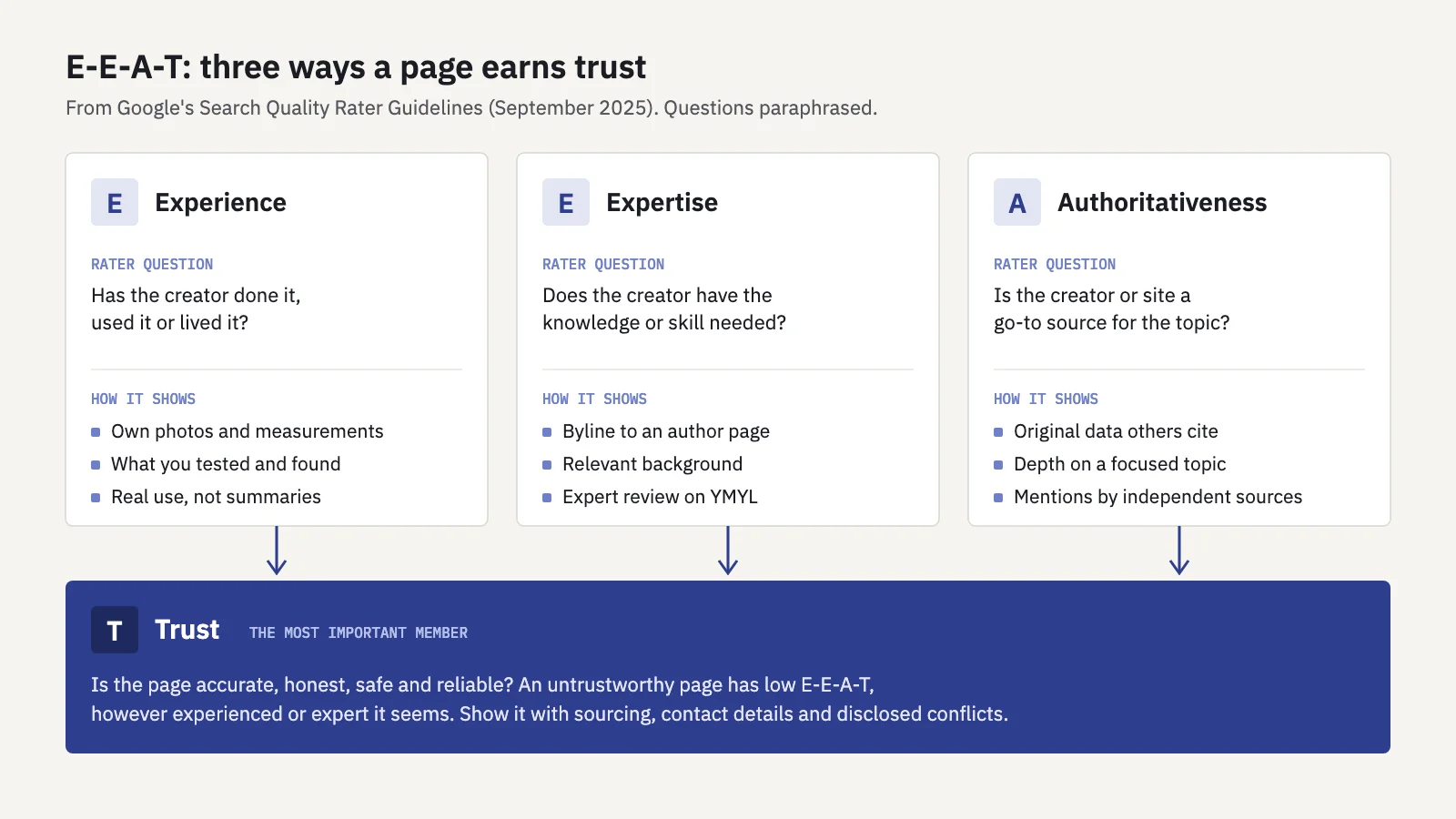
Trust is the core; the other three are ways a page earns it.
Is E-E-A-T a ranking factor?
Not directly. Google's guide to creating helpful, reliable, people-first content says: "While E-E-A-T itself isn't a specific ranking factor, using a mix of factors that can identify content with good E-E-A-T is useful." Its systems identify "a mix of factors" that indicate experience, expertise, authoritativeness and trust, and they give that mix more weight on Your Money or Your Life (YMYL) topics: health, financial stability, safety and the welfare of society.
The raters don't rank anything either. The same page says rater data "is not used directly in our ranking algorithms". Google compares it to feedback cards in a restaurant: it tells Google whether its systems are working. The rater guidelines themselves say no single rating can directly change how a page appears in search.
So the honest summary is this: E-E-A-T describes what Google's systems try to reward. There's no E-E-A-T score inside Google, and there's none you can pull out of a tool. Any "E-E-A-T score" you see is someone's estimate.
How to show experience and expertise on a page
Google's helpful content guide frames this as three questions about every piece of content: Who made it, How it was made, and Why. Turned into page-level practice:
| Component | What to show on the page | What to avoid |
|---|---|---|
| Experience | Your own photos, measurements, test results, screenshots of real use; what you did and what happened | Stock images and summaries of other people's reviews |
| Expertise | A byline that leads to an author page with relevant background; for YMYL, a named reviewer with credentials | Fabricated authors, AI headshots, invented credentials |
| Authoritativeness | Original data or research others cite; depth on a focused topic | Spreading thin across topics you don't know |
| Trust | Clear sourcing, accurate facts, visible contact and About information, disclosed conflicts of interest | Changing the date without changing the content |
A few points from Google's guidance deserve to be quoted precisely:
- Bylines. Google "strongly encourage[s] adding accurate authorship information, such as bylines to content where readers might expect it". It also calls fabricated creator profiles, such as AI-generated headshots or false credentials, "a form of deception".
- How it was made. For product reviews, readers trust content more when it explains how many products were tested, how, and with what results, with evidence such as photos. If automation or AI substantially generated the content, say so where readers would expect to know.
- Why it exists. The "why" should be helping people who'd come to your site directly. Content made primarily to attract search visits isn't what the systems reward.
- Freshness. Changing a page's date to make it look fresh when the content hasn't substantially changed is on Google's list of warning signs.
The rater guidelines add one more check: what others say about you. Raters are told to look at independent reviews, news coverage and references, not only your About page. That part of E-E-A-T lives mostly off your site.
What Search Console can't tell you
Search Console reports clicks, impressions, CTR and average position. None of these measures E-E-A-T. A page can lose clicks because demand fell, a competitor published something better, an AI Overview answered the question, or Google changed how it ranks the whole topic. A page can gain clicks with mediocre E-E-A-T because nothing better exists yet.
What Search Console does give you is outcomes, sliced by query, page, date, country, device and search appearance. If you improve E-E-A-T signals on a set of pages and their outcomes move against the rest of the site, that's evidence, not proof. Treat everything below that way.
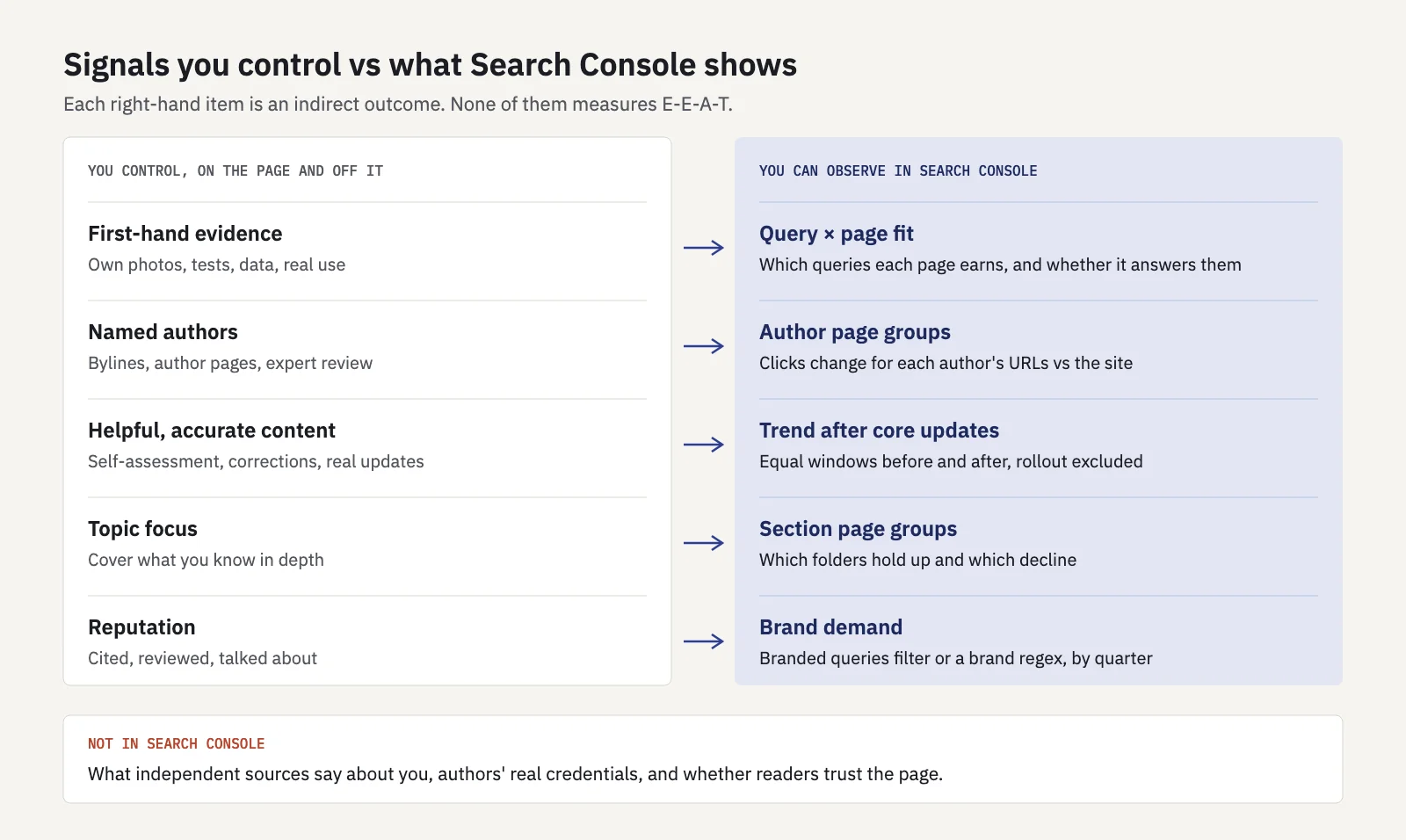
Left: what you can change. Right: where you might see an effect. Nothing on the right measures E-E-A-T directly.
Indirect signal 1: query × page fit
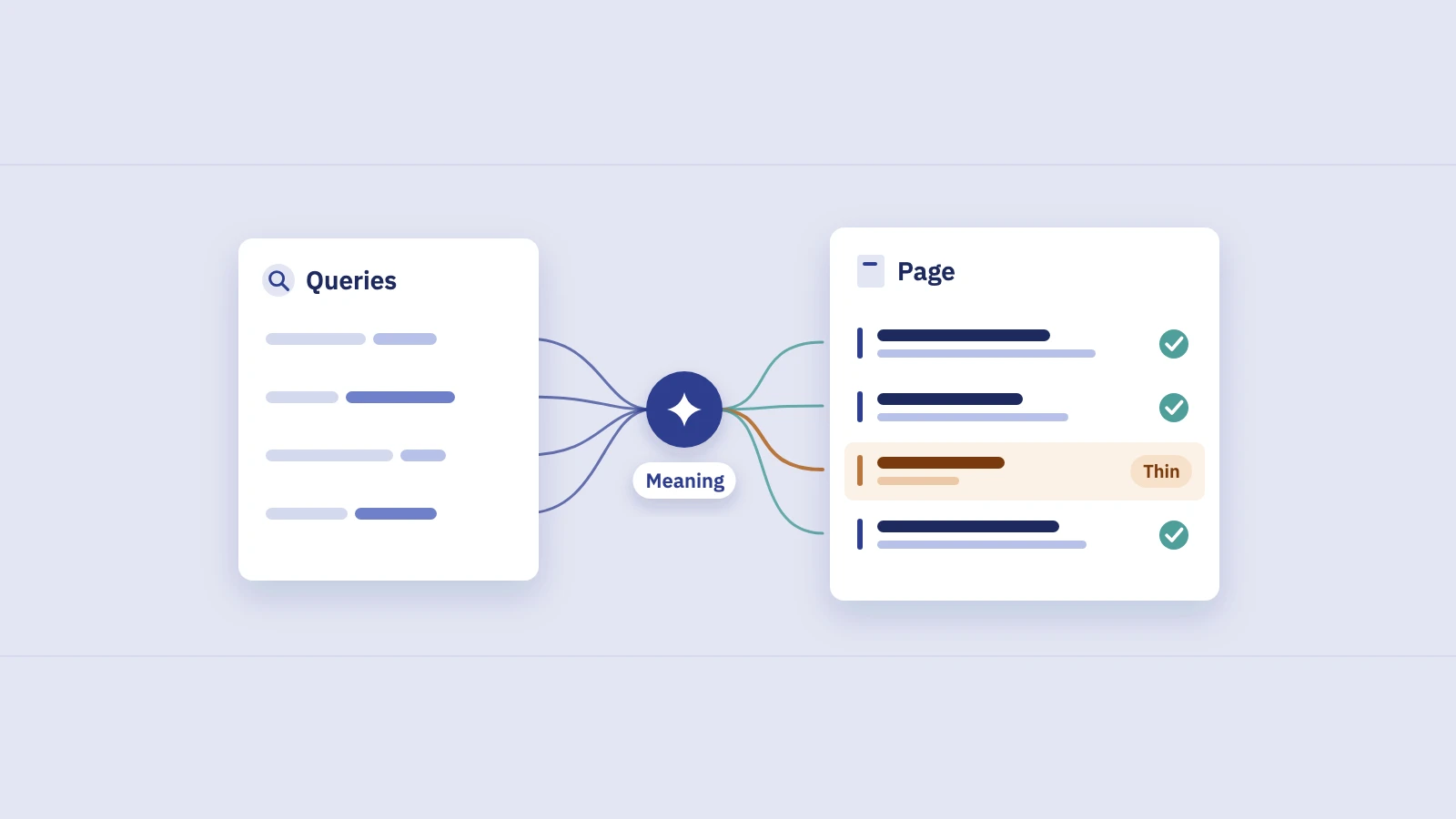
Look at which queries each page actually earns impressions for, and whether they match what the page and its author can credibly answer.
- Open Performance > Search results, set the date to the last 3 months, and click + Add filter > Page with the exact URL.
- Open the Queries tab and sort by Impressions.
- Mark each top query as on-topic (the page answers it with first-hand detail) or off-topic (the page ranks for it but doesn't really answer it).
- Compare CTR and position for the two sets. Off-topic queries often sit at low positions with low CTR. That's a sign the page is being tested for intent it doesn't serve.
- Decide per query: add a real section that answers it with experience or expertise, or leave it to a page that does.
This is a fit check, not an E-E-A-T score. But a page whose queries match what its author knows tends to be the page that shows experience convincingly. In Serplyze, the Query × page tab on Traffic lists every query against the URL that earns it for the whole site, so you can review fit across pages without filtering one URL at a time.
Indirect signal 2: trends after core updates
Core updates are where Google's assessment of quality and helpfulness shifts most visibly. Google's core updates documentation points site owners who lose ground to the same helpful content questions this post started with.
The measurement method (equal windows before and after the rollout, rollout days excluded, a year-earlier check for seasonality) is covered step by step in our guide to core update impact in Search Console. For E-E-A-T, the useful part is the split: which page types, topics and authors moved, and in which direction. A sitewide drop says little. A drop concentrated in thin, unattributed pages while expert-written pages held is a pattern worth acting on.
Search Console now lets you right-click the Performance chart to add custom annotations, so you can mark rollout dates and your own content changes on the same chart. Serplyze draws Google update markers on its charts automatically from the Google Search Status Dashboard.
Indirect signal 3: which authors and sections hold up
If you've invested in named authors, expert reviewers or first-hand testing for part of the site, compare that part with the rest. The comparison works when each group is big enough and the windows are the same.
- Define the groups. Sections are usually folders (
/reviews/,/guides/). Authors rarely are, so list each author's URLs from your CMS. - Pull each group. In Search Console, use a Page filter with Custom (regex) to match a folder, or a pattern such as
/(slug-one|slug-two|slug-three)/for a list of an author's URLs. - Use equal windows. Compare 28 or 56 days against the same length before, and the same days last year.
- Read the change, not the total. A section with fewer clicks but a smaller decline than the site average is holding up.
- Control for topic. If one author writes only seasonal content, the comparison says more about the season than the author.
Serplyze's page groups save this setup: a group matches URL rules or up to 200 pinned URLs, and the Groups tab on Traffic shows every group's clicks, impressions and change side by side, so you don't rebuild filters each quarter. See content groups.
Indirect signal 4: brand demand
Authoritativeness and trust are partly about reputation, and one visible trace of reputation is people searching for you by name. Search Console's branded queries filter splits Performance data into branded and non-branded where your property is eligible. Where it isn't, a Query filter with a regex for your brand terms does the job. Our guide to branded vs non-branded traffic covers both.
Rising branded impressions over months suggest growing recognition. It's a slow, noisy signal, influenced by marketing and seasonality as much as content, so read it in quarters, not weeks.
A quarterly E-E-A-T review
- Pick the pages that matter: YMYL pages first, then the pages that earn the most non-branded clicks.
- Audit each against the table above: who wrote it, what first-hand evidence it shows, what it cites, when it last changed in substance.
- Check query fit for each and note off-topic queries.
- Fix the biggest gaps: add real bylines and author pages, add evidence of testing, correct errors, cut or merge pages nobody can vouch for. A content audit gives you the full inventory.
- Log the changes with dates, so later trends can be read against them.
- Compare groups after the next core update and after 8 to 12 weeks of normal ranking, using equal windows.
Expect slow, partial feedback. Google's systems reassess pages over time, and many factors move at once. A quarter is a reasonable unit; a week is not.
Key takeaways
- E-E-A-T (experience, expertise, authoritativeness, trust) comes from Google's rater guidelines; trust is the most important part.
- Google says E-E-A-T itself isn't a specific ranking factor, and rater data isn't used directly in ranking; its systems look for a mix of factors that align with it, weighted more on YMYL topics.
- Show it on the page: accurate bylines and author pages, first-hand evidence, clear sourcing, honest dates and disclosed conflicts.
- Search Console can't measure E-E-A-T. It can show indirect outcomes: query × page fit, trends after core updates, how author or section groups hold up, and brand demand.
- Compare groups over equal windows and treat the results as evidence, not proof.
Serplyze groups your pages by section or author and shows how each group moves across Google updates, all from your own Search Console data. Start free.